Best Photos for Custom Canvas Prints: What Works and What Does Not
Choosing the right photo is one of the most important steps when ordering custom canvas prints. A beautiful image can become meaningful wall art, but not every photo will print well on canvas. Some images look great on a phone screen but appear blurry, dark, cropped, or unbalanced once printed large. If you want to turn your favourite memories into high-quality canvas prints, understanding what works—and what does not—can help you get a result you will be proud to display.
Canvas printing is different from viewing photos digitally. On a phone, small imperfections are easy to miss. On a wall, every detail becomes more noticeable. Resolution, lighting, composition, colour, and cropping all affect the final result. This guide will help you choose the best photos for custom canvas prints and avoid common mistakes before you order.
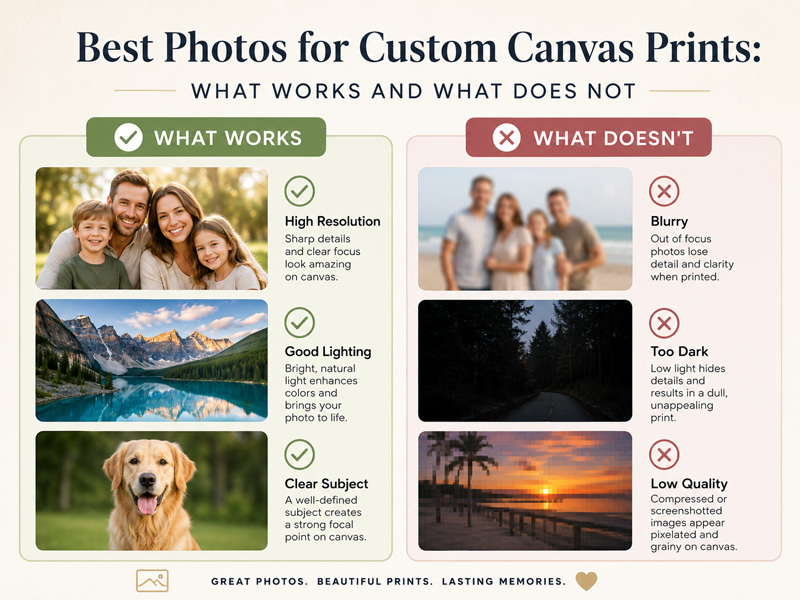
Why Photo Choice Matters for Canvas Prints
A canvas print is designed to be seen from a distance, often as part of a living room, bedroom, hallway, or office. The image needs to be clear enough, balanced enough, and meaningful enough to work as wall art.
Many customers choose photos based only on emotion. That is understandable—a family photo, wedding moment, pet portrait, or travel memory may feel special. But emotion alone does not always guarantee a good print. A photo may be meaningful but too blurry, too dark, or too tightly cropped for a large canvas.
The best canvas print starts with a photo that has both emotional value and technical quality.
Photos That Work Best for Custom Canvas Prints
1. High-Resolution Photos
High-resolution images are the best choice for canvas printing, especially for medium and large sizes. A photo that looks sharp on your phone may not have enough detail for a large wall print.
As a general rule, original camera files are better than screenshots, social media downloads, or compressed images. Photos taken with modern smartphones can often work well, especially when taken in good light, but the original file should be used whenever possible.
If you are printing a large canvas, avoid using images that have been heavily zoomed, cropped, or sent through messaging apps that reduce quality.
2. Bright, Clear Photos
Good lighting makes a huge difference. Bright photos usually print better than dark photos because canvas material has texture, and very dark areas may lose detail.
Outdoor photos taken in natural light often work beautifully. Family portraits, beach photos, garden photos, travel images, and pet photos taken in soft daylight usually produce strong results.
Indoor photos can also work, but they should be well lit. If the image looks grainy, shadowy, or unclear on your screen, it may not improve when printed.
3. Photos with a Clear Main Subject
A good canvas print should have a clear focal point. This could be a person, couple, family, pet, landscape, building, or special object.
Photos with one strong subject are easier to print and display. For example, a child smiling at the camera, a couple standing in a scenic location, or a dog sitting in soft light can all work well.
Images that are too busy may look confusing as wall art. If there are too many people, objects, or background distractions, the final canvas may feel cluttered.
4. Well-Composed Images
Composition refers to how the subject is placed within the photo. A well-composed image feels balanced and natural.
For canvas prints, photos with enough space around the subject usually work better than photos cropped too tightly. This is especially important because canvas prints may require wrap edges, mirror edges, or small trimming during production.
If a face, hand, pet ear, wedding dress, or important object is too close to the edge, it may be difficult to print without losing part of the image.
5. Meaningful Personal Photos
The best custom canvas prints are not always technically perfect studio photos. They are often meaningful personal memories: family portraits, wedding photos, newborn images, travel adventures, graduation moments, pet portraits, or anniversary photos.
A canvas print should feel personal. If the photo makes you smile, reminds you of a special moment, or represents an important part of your life, it may be a great candidate—as long as the quality is good enough.
Photos That May Not Work Well
1. Blurry or Out-of-Focus Photos
Blurry photos are one of the biggest problems in canvas printing. If the subject is not sharp, printing it larger will make the blur more obvious.
Motion blur, camera shake, or poor focus cannot usually be fixed completely. Some slight softness may be acceptable for small prints, but for large canvas prints, sharpness matters.
Before ordering, zoom in on the photo. If faces, eyes, or key details look unclear, it may not be the best choice.
2. Very Dark Photos
Dark images can lose detail when printed. Shadows may become heavier, and important parts of the image may disappear.
This often happens with indoor party photos, evening photos, or images taken without enough light. If the photo already looks dark on screen, it may look even darker as a canvas print.
Some editing can help, but heavily brightening a dark image may create noise or grain. It is better to start with a naturally bright photo if possible.
3. Screenshots and Social Media Downloads
Screenshots are usually not ideal for canvas printing. They often have lower resolution and may include compression, interface elements, or hidden quality loss.
Photos downloaded from Facebook, Instagram, or messaging apps are also often compressed. They may look fine on a small screen but become pixelated when enlarged.
Whenever possible, use the original photo file from your camera or phone.
4. Photos with Important Details Too Close to the Edge
Canvas prints often need edge handling. Depending on the wrap style, part of the image may continue around the side of the frame, be mirrored, or be adjusted.
If important details are too close to the edge, they may be affected. For example, a person’s face near the border, a pet’s ears at the top, or text near the side may not print cleanly.
Choose photos with some breathing room around the subject.
5. Low-Light Photos with Heavy Grain
Photos taken in poor lighting often contain digital noise or grain. This can become more visible when printed.
Grain may be acceptable in artistic black-and-white photos, but for family portraits or clean home décor prints, it can reduce the professional look of the canvas.
How to Check If Your Photo Is Suitable
Before ordering a canvas print, take a few simple steps.
First, zoom in on the image. Check the most important area, such as faces, eyes, pets, or landscape details. If these areas look sharp, that is a good sign.
Second, check the lighting. Make sure the image is not too dark, overly yellow, or washed out.
Third, consider the crop. Imagine the image as a finished wall print. Does the subject have enough space around it? Will it look balanced above furniture or on a feature wall?
Fourth, use the original file. Avoid screenshots or compressed versions.
Best Photo Types for Different Canvas Print Ideas
For living room canvas prints, choose images with strong visual impact, such as family portraits, landscape photos, wedding photos, or travel memories.
For bedroom canvas prints, softer images often work best. Calm colours, romantic photos, baby portraits, or nature scenes can create a relaxing mood.
For office canvas prints, landscapes, city views, motivational images, or clean abstract photography can make the space feel more inspiring.
For gifts, choose emotional photos: grandparents with grandchildren, wedding memories, pet portraits, newborn photos, or meaningful travel moments.
Final Thoughts
The best photos for custom canvas prints are clear, high-resolution, well-lit, well-composed, and emotionally meaningful. The photos that usually do not work well are blurry, dark, heavily compressed, tightly cropped, or too low in quality.
Choosing the right image before ordering can make a major difference in the final result. A carefully selected photo can become beautiful wall art that brings personality, warmth, and meaning into your home.
Your favourite memories deserve to be displayed at their best. By understanding what works and what does not, you can create custom canvas prints that look professional, feel personal, and last for years.
Recent Posts
-
Canvas Photo Prints Custom Guide: How to Turn Your Favourite Photos into Wall Art
Some of the most meaningful photos in your life are probably sitting on your phone, computer, or clo …23rd Sep 2026 -
Print Photos onto Canvas for Living Room Wall Art Ideas
Your living room is one of the most important spaces in your home. It is where family gathers, guest …16th Sep 2026 -
How to Create a Custom Canvas Photo Print That Looks Professional
A custom canvas photo print is more than just putting an image onto a piece of fabric. When desi …28th Aug 2026