How to Paint Photos on Canvas: A Complete Guide to Turning Your Memories Into Artwork
Turning a photograph into a canvas painting is one of the most meaningful ways to preserve memories. Unlike digital images stored on a phone, a painted canvas adds texture, depth, and artistic interpretation that transforms a simple moment into a long-lasting visual centerpiece.
If you're exploring professional-quality inspiration or ready-made solutions, services like photos on canvas show how modern printing and artistic finishing can help bridge the gap between photography and fine art.
This guide explains how to paint photos on canvas, whether you're doing it yourself or preparing your image for a professional transformation. It covers materials, techniques, common mistakes, and design principles that ensure your final artwork looks intentional and visually compelling.
Why Turn Photos Into Canvas Paintings?
Before jumping into the process, it’s important to understand why this trend has become so popular in home décor and gifting.
1. Emotional value
A painted photo is more than an image—it becomes a story. Family portraits, wedding moments, and travel memories gain emotional depth when recreated on canvas.
2. Interior design impact
Canvas paintings integrate seamlessly into living rooms, bedrooms, and offices. They feel more “art gallery” than standard framed photos.
3. Personalization
Unlike mass-produced wall art, a painted photo is fully customized. You control style, colors, brushwork, and mood.
4. Longevity
Canvas materials and acrylic paints are highly durable compared to standard paper prints, especially when properly sealed.
Understanding the Two Main Approaches
When people search for “how to paint photos on canvas,” they usually fall into two categories:
Approach A: Hand-Painted Canvas From a Photo (DIY or Artist)
This involves manually recreating a photo using paints (typically acrylic or oil).
Approach B: Digital-to-Canvas Conversion (Print + Artistic Finish)
The photo is digitally processed, printed on canvas, and sometimes enhanced with hand-painted details.
Both approaches are valid, but they require different levels of skill and tools.
Materials You Need (DIY Method)
If you're planning to paint a photo onto canvas yourself, prepare the following:
- Stretched canvas (cotton or linen)
- Acrylic paints (recommended for beginners)
- Brushes (fine detail + flat brushes)
- Palette and mixing tray
- Pencil or charcoal for sketching
- Projector or tracing paper (optional but helpful)
- Matte medium or varnish for finishing
- Reference photo (high-resolution is best)
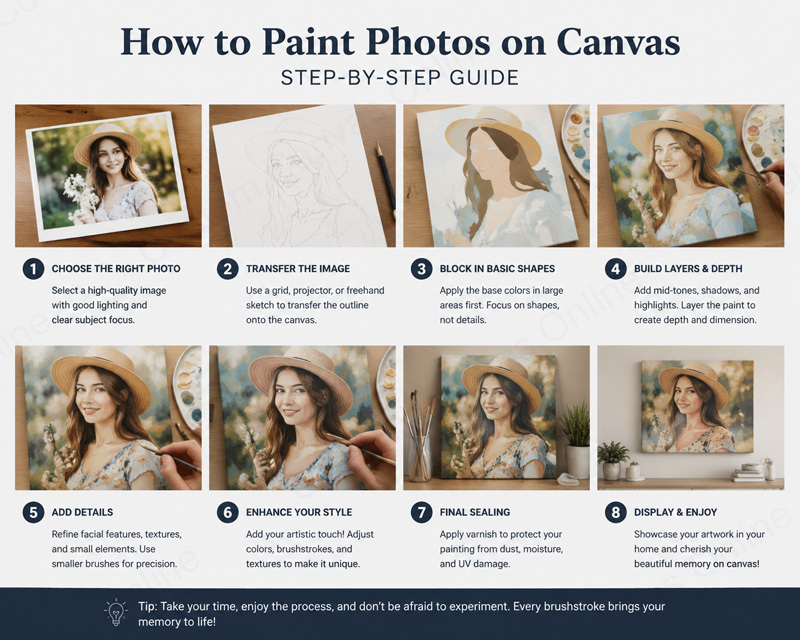
Step-by-Step: How to Paint Photos on Canvas
Step 1: Choose the right photo
Not all photos work well as paintings. Choose images with:
- Strong lighting contrast
- Clear subject focus
- Simple backgrounds
- Emotional or meaningful composition
Portraits, pets, and landscapes are ideal.
Step 2: Prepare the canvas
Apply a light base coat (gesso if needed). This helps paint adhere better and prevents absorption issues.
Step 3: Transfer the image
There are several ways to transfer your photo:
- Grid method: Divide both canvas and photo into squares and replicate proportionally
- Projection method: Use a projector to trace outlines directly
- Freehand sketching: Best for experienced artists
Focus on proportions first—details come later.
Step 4: Block in basic shapes
Start with large color areas:
- Background first
- Skin tones or main subject
- Shadows and light zones
Avoid details at this stage. Think in “shapes,” not “objects.”
Step 5: Build layers and depth
This is where the transformation happens:
- Add mid-tones
- Refine shadows and highlights
- Adjust color temperature
- Blend edges for realism or stylized effect
Acrylic dries quickly, so layering is efficient.
Step 6: Add details
Once the structure is solid, refine:
- Eyes, facial features, textures
- Fabric folds
- Hair strands or natural elements
Use smaller brushes for precision.
Step 7: Enhance artistic style
A photo painting should not be a copy—it should be an interpretation.
You can choose styles such as:
- Realistic portrait painting
- Impressionist brushwork
- Minimalist color blocking
- Abstract reinterpretation
This is where creativity matters most.
Step 8: Final sealing
Apply varnish to protect the surface from dust, UV light, and moisture. Matte or gloss finishes depend on your desired aesthetic.
Common Mistakes to Avoid
1. Using low-resolution photos
Blurry images lead to distorted proportions and weak compositions.
2. Over-detailing too early
Many beginners start with eyelashes or textures before fixing structure.
3. Ignoring background balance
A strong subject can still fail if the background feels cluttered or flat.
4. Wrong color matching
Skin tones and lighting shifts are often misinterpreted. Always test colors before applying.
Professional Alternative: When DIY Is Not Enough
Not everyone has the time or skill to paint manually. In these cases, professional canvas conversion is a practical solution.
Modern studios can:
- Digitally enhance your photo
- Apply artistic filters
- Print on high-quality canvas
- Add hand-painted textures for realism
This hybrid method delivers a “painted look” without requiring traditional painting skills.
Design Tips for Better Results
Choose meaningful compositions
Close-up portraits or emotionally strong moments work best.
Consider wall placement
Large canvases suit focal walls; smaller pieces work in gallery-style arrangements.
Match interior style
- Minimalist homes → black & white or muted tones
- Modern interiors → bold colors and contrast
- Classic interiors → warm, soft brush styles
Think in series
Instead of one image, consider a 2–3 canvas set to tell a visual story.
Learning how to paint photos on canvas is not just a technical exercise—it’s a way of translating memory into art. Whether you choose a hands-on painting approach or a professional canvas transformation, the goal is the same: to preserve meaningful moments in a visually lasting form.
With the right photo selection, careful layering, and attention to composition, any image can become a centerpiece worthy of display.
Recent Posts
-
Canvas Photo Prints Custom Guide: How to Turn Your Favourite Photos into Wall Art
Some of the most meaningful photos in your life are probably sitting on your phone, computer, or clo …23rd Sep 2026 -
Print Photos onto Canvas for Living Room Wall Art Ideas
Your living room is one of the most important spaces in your home. It is where family gathers, guest …16th Sep 2026 -
How to Create a Custom Canvas Photo Print That Looks Professional
A custom canvas photo print is more than just putting an image onto a piece of fabric. When desi …28th Aug 2026